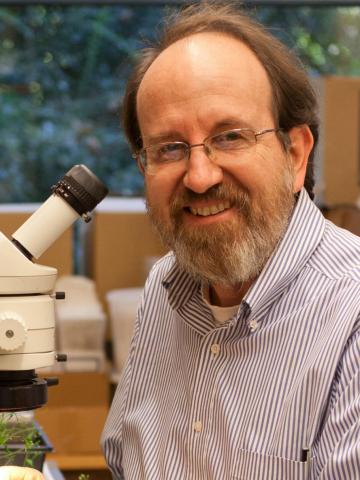
Scott Poethig
John H. and Margaret B. Fassitt Professor
Phone: 215-898-8915
spoethig@sas.upenn.edu
School: Arts & Sciences, Biology
General Topic Areas: Plant Development, The Genetics of Food
Sample Talk Topics or Titles:
- Nothing You Eat is Natural: The Genetics of Food
The animals and plants we eat for breakfast, lunch, and dinner usually bear only a passing resemblance to their ancestors. Ever since humans became farmers, we have been consciously and unconsciously genetically modifying the organisms we eat. Many of the foods we now consider “healthy” were once toxic to us. I will discuss the many ways that both farmers and scientists have created everything you find in a supermarket. You will never look at the food on your plate in the same way again! - How to Spend a Quiet Evening with a Potato
Plants have relatively few parts (leaves, stems, roots and flowers), but these parts come in many disguises. Leaves are the salad on your plate, and the celery and onions too. Juvenile and adult shoots of the same plant may be so different that they seem to be different species. And then there are root vegetables, and things that look like root vegetables, but aren’t; e.g. potatoes. Learning to recognize your dinner’s true identity brings insight and understanding where previously there were only vegetables. - How Leaves Change Their Identity
Leaves produce all the oxygen in the air we breathe and all the energy in the food we eat, but they rarely attract much attention. However, there is more to a leaf than being green. Leaves come in all shapes and sizes, and are masters of disguise. They do one thing when a plant is young, and another thing when it is older. This phenomenon was described in 1790 by the poet Goethe in his book “The Metamorphosis of Plants”, but its genetic and molecular basis have only been discovered recently. The evolutionary, ecological, and practical significance of this discovery will be discussed. - Yes, we have no bananas: the biology, history, and politics of America’s favorite fruit
All the bananas in the supermarket were imported from another country, usually one in Central America. How this came to be is story of business acumen and political intrigue. From Philadelphia to Japan, the bananas found a supermarket are genetically identical (although the Japanese have found a way to make their version sweeter). This genetic uniformity could spell the end of this popular fruit, as a deadly fungus makes its way around the world. Will a GMO banana save the banana split? - Coffee, Tea, and Chocolate: Our Favorite Addictions
Together, these three products have a market value greater than any other food we eat, and this includes the big ones—corn, rice, wheat, and soybeans! The reason is caffeine and theobromine. The molecules are chemically similar to cocaine, morphine and nicotine, but are less potent. The chemistry, biology, and processing of coffee, tea and cacao will be discussed. - Deconstructing the Tomato, America’s Favorite “Vegetable”
Tomatoes are vegetables only because the U.S. Supreme Court says so. To biologists, they are fruit, and very tasty ones—so long as you grow them yourself and choose the varieties carefully. Like most Americans, the tomato is an immigrant. Born in South America, raised in Mexico and Europe, and imported into North America, where it flourishes in gardens everywhere. Why are tomatoes red, orange, brown and green? Should I plant hybrids or heirlooms? These and other burning questions will be answered. - How I Got a Letter from Abeche, Chad: the history, pre-history, and politics of one of Africa’s most troubled countries (as told through its stamps)
This is a story about becoming a stamp collector late in life, and how this hobby cultivated an appreciation of the history and cultures of Africa and produced friends around the world. One such friend was Erik Chénier, a contractor for a French army post in Chad, one of Africa’s most troubled countries. The stamps of Chad tell its ancient and modern history, and the history of the countries that occupied it.